How Games and Tech Rewire Thinking Faster Than Traditional Education
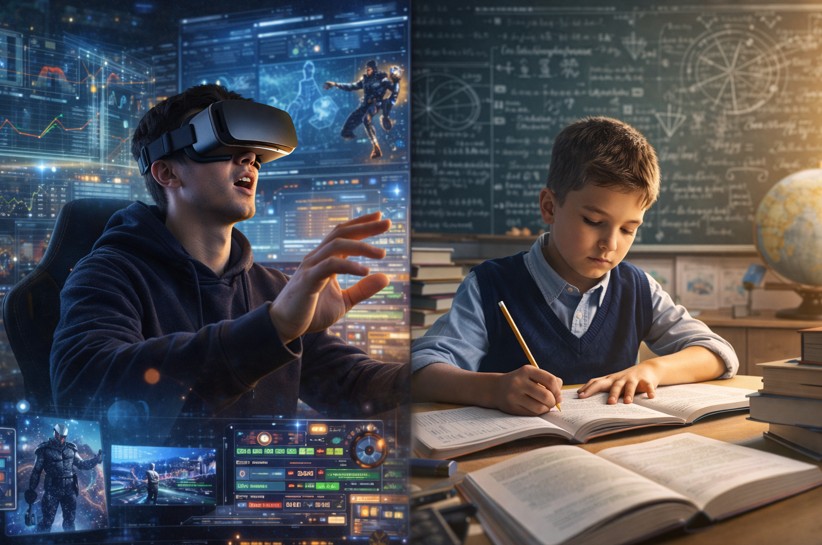
Why games and technology are changing our thinking faster than education
Education still speaks in semesters. Games and modern platforms speak in seconds.
That gap matters because thinking changes at the speed of feedback. A classroom can be brilliant and still be slow: one teacher, thirty students, one pace, one test that arrives long after the mistake. Meanwhile, a puzzle app corrects you instantly. A multiplayer match punishes a lazy decision in the next ten seconds. A recommendation feed teaches you what holds attention, even when you hate what it’s teaching.
The result is not that schools are “behind,” as if they forgot to update an app. The result is that the daily training ground has moved. In 2026, people spend more hours inside systems that measure, respond, and adapt than inside systems that wait for grades. That is why games and technology are changing how people decide, focus, remember, and recover from failure faster than formal education can keep up.
The fastest teacher is the one who answers back
A good teacher doesn’t just explain; a good teacher listens and answers. Games do that by design. In chess, a blunder is revealed on the board, not in a teacher’s margin two weeks later. In Counter-Strike 2, a bad peek is corrected by the scoreboard and the silence of teammates. In Duolingo, a missed word returns until it stops being missed.
This isn’t magic. It’s a learning loop that runs tight: attempt, feedback, adjustment, repeat. Education researchers have spent decades describing why retrieval practice and spacing beat passive rereading, and why memory strengthens when the brain has to pull information back out. Games industrialize that principle, then put it on everyone’s phone.
Micro-failures beat midterms
Most school failure is theatrical: one big exam, one high-stakes grade, one label that can stick. Games teach a rougher, kinder truth. You fail constantly. You respawn.
That rhythm changes the psychology of effort. When failure is small and frequent, it becomes information rather than humiliation. The mind learns to separate identity from outcome, which is a sophisticated skill that many adults still struggle to name.
A game doesn’t ask for courage once. It asks for it in tiny coins.
Practical habits that come from this “micro-failure” training:
- Breaking a big goal into repeatable runs.
- Treating mistakes as data, not drama.
- Resetting quickly after a bad decision.
- Reviewing the process, not only the result.
Attention is now a skill, not a mood
Education often assumes attention is a trait: either you have it, or you don’t. Technology treats attention as a resource that can be shaped, captured, and spent.
Games teach attentional control through constraints. A battle royale demands scanning, prioritizing, and timing. A strategy title forces planning while the clock keeps moving. Even a simple rhythm game drills prediction: the brain learns to see a beat coming.
Outside games, the same mechanics are everywhere. Notifications, streaks, and endless feeds train short cycles of reward. Schools then compete with a world that has already trained students to expect an immediate response. It’s not a moral failure; it’s an economic design.
Odds, intuition, and the new math literacy
Nothing exposes the difference between feeling and probability faster than sport. A fan sees momentum. A bettor sees the price. In the modern ecosystem, match clips, injury updates, and live statistics circulate at the pace of group chats.
Serious bettors compare all betting programs (Arabic: جميع برامج المراهنات) with the same instinct a player uses when choosing a loadout: the interface must be fast, the markets must be clear, and the odds must update without confusion. That comparison trains a kind of applied numeracy that many classrooms struggle to make visceral. People start thinking in implied probability, not in slogans. They learn that “sure thing” is usually just a story that hasn’t met the data yet.
This doesn’t turn everyone into a quant. It does teach a habit that education often fails to reward: estimating under uncertainty, then living with variance. A well-argued prediction can lose. A lazy guess can win. The lesson is brutal, but honest.
AI tutors are arriving, and the one-speed classroom can’t compete
Personalized instruction has been a dream since Benjamin Bloom wrote about mastery learning. What has changed is the machine. In 2026, AI tutoring is no longer a futuristic poster; it’s a product category. It can generate practice questions, explain steps, and vary difficulty on demand.
That doesn’t mean it replaces teachers. It means the baseline expectation shifts. When a student can ask a tool for ten examples at midnight, the classroom becomes a place for human work: discussion, ethics, teamwork, and critique.
For the betting audience, platforms already operate like tutors. One widely recognized option, MelBet (Arabic: ميل بت), fits into this shift by packaging choice, feedback, and learning into a routine that repeats: lines appear, prices move, results settle, and the next decision comes quickly. Features that matter are not glamorous; they are cognitive. A clean mobile flow reduces friction, live and pre-match markets make comparisons easier, and built-in stats encourage evidence over superstition. When a major event hits the calendar, the platform can surface it as a dedicated category, which turns scattered curiosity into a structured decision space.
The last classroom is the one you return to tomorrow
Schools still matter because they carry legitimacy, community, and the long memory of society. But the daily shaping of thought increasingly happens elsewhere, in systems that reward speed, iteration, and attention.
The task is not to romanticize games or demonize education. It’s worth noticing where your mind is being trained. Games and technology are teaching faster because they answer faster. They correct faster. They seduce faster.
The useful takeaway is simple and immediate: choose your training ground. Pick games and tools that reward patience, probability, and reflection. Let the rest scroll past.